Innovations in Automobile Bearings How Advanced Bearing Technologies
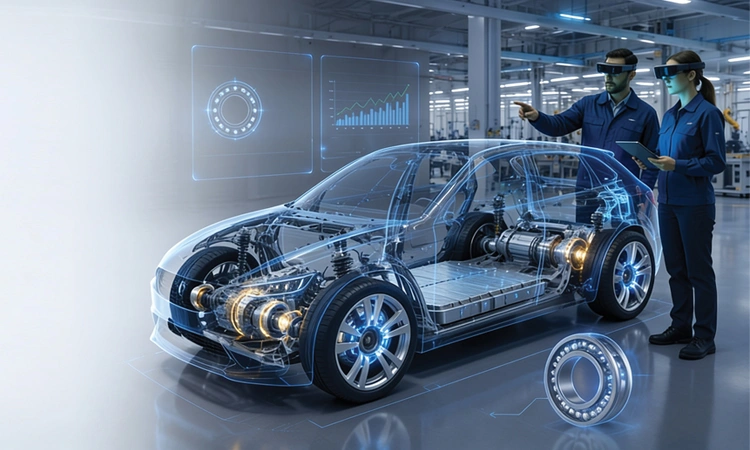
The automotive industry is undergoing one of the most significant transformations in its history. From electric vehicles (EVs) and hybrid powertrains to connected mobility, autonomous driving and lightweight vehicle design, every aspect of vehicle engineering is evolving. Amidst these sweeping changes, one critical component continues to play a pivotal role in ensuring reliability, efficiency and safety-the automobile bearing.
Though often hidden from view, bearings are indispensable to the performance of every vehicle. They support rotating components, minimise friction, withstand heavy loads and ensure smooth operation of systems ranging from wheel hubs and transmissions to steering assemblies and electric motors. As vehicle technology advances, bearing manufacturers are responding with innovative products that offer greater precision, longer life, lower friction and intelligent monitoring capabilities. For India, now one of the world’s largest automobile producers and a rapidly emerging global manufacturing hub, innovations in automotive bearings are opening new opportunities for technology development, localisation and exports.
Meeting the Demands of Next-Generation Vehicle
Modern vehicles demand far more from bearings than their predecessors. Higher engine efficiencies, downsized powertrains, stringent emission norms and enhanced passenger comfort require bearings capable of operating under increasingly challenging conditions.
The rapid rise of electric vehicles has further accelerated innovation. Unlike conventional internal combustion engines, electric motors operate at much higher rotational speeds while generating instant torque. EV bearings must therefore deliver exceptional speed capability, reduced friction, minimal vibration and excellent thermal stability. Since electric powertrains operate almost silently, even the slightest bearing noise becomes noticeable, making ultra-quiet operation a key design requirement.
Manufacturers are consequently redesigning bearings to meet these evolving performance expectations.
Reducing Friction for Greater Efficiency
Every reduction in friction translates into improved energy efficiency. In conventional vehicles, low-friction bearings contribute to better fuel economy and reduced carbon emissions. In electric vehicles, they help maximise battery range by reducing energy losses. Innovations include optimised raceway geometries, improved rolling element profiles, advanced cage designs and ultra-smooth surface finishes. Special low-viscosity lubricants further minimise resistance without compromising durability. These seemingly small improvements collectively deliver measurable gains in vehicle performance while extending bearing life.
Advanced Materials Drive Higher Performance
Material science is revolutionising bearing technology. High-purity bearing steels with fewer inclusions provide significantly greater fatigue resistance. Advanced heat-treatment processes enhance hardness while improving dimensional stability under varying temperatures. Hybrid ceramic bearings, which combine steel rings with ceramic rolling elements, are increasingly finding applications in premium vehicles and electric drivetrains. Compared with conventional steel bearings, hybrid bearings offer lower weight, higher speed capability, reduced friction, superior corrosion resistance and excellent electrical insulation. These characteristics make them particularly suitable for electric vehicles, where electrical currents generated by high-speed motors can otherwise damage conventional bearings.
Smart Bearings Enter the Automotive Mainstream
Perhaps the most exciting development is the emergence of intelligent or smart bearings. Integrated sensors embedded within the bearing continuously monitor operating parameters such as:
• Temperature
• Rotational speed
• Load
• Vibration
• Alignment
• Lubrication condition
The collected data enables real-time health monitoring and predictive maintenance. Instead of replacing bearings at fixed intervals, vehicle manufacturers and fleet operators can determine the actual condition of components, reducing maintenance costs while preventing unexpected failures. Sensor-integrated bearings also play an important role in Anti-lock Braking Systems (ABS), Electronic Stability Control (ESC), traction control and Advanced Driver Assistance Systems (ADAS), all of which rely on accurate wheel-speed information.
![]() Innovative Lubrication Technologies
Innovative Lubrication Technologies
Lubrication remains fundamental to bearing performance. Today’s automotive bearings increasingly utilise high-performance synthetic greases capable of operating across wider temperature ranges while maintaining consistent lubrication properties over extended periods. Many wheel hub and transmission bearings are now sealed and lubricated for life, eliminating maintenance throughout the vehicle’s service life. Researchers are also exploring nano-lubricants containing microscopic additives that reduce friction, minimise wear and improve heat dissipation. These next-generation lubricants promise further improvements in efficiency and durability.
Improved Sealing for Longer Service Life
Contamination is among the leading causes of bearing failure. Manufacturers have responded by developing sophisticated sealing technologies using advanced elastomer materials and multi-lip sealing arrangements that effectively prevent the ingress of dust, mud, moisture and road contaminants. Enhanced sealing systems not only protect bearings but also retain lubricants more effectively, significantly extending operational life under demanding Indian road conditions.
Lightweight Designs Support Sustainable Mobility
Vehicle lightweighting has become an essential strategy for improving fuel economy and extending EV driving range. Bearing manufacturers are contributing by developing compact bearing units, thinner cross-sections and lightweight cages made from high-performance polymers. Despite reduced weight, these bearings continue to deliver high load-carrying capacity and exceptional durability. Compact integrated bearing units also simplify assembly, reduce manufacturing complexity and improve overall vehicle design flexibility.
Precision Manufacturing Enhances Reliability
Modern bearing manufacturing has become a showcase for advanced engineering. Leading manufacturers employ CNC grinding, super-finishing, robotic assembly, laser measurement systems and AI-enabled quality inspection to achieve micron-level accuracy. Industry 4.0 technologies, including machine learning, digital twins and real-time production monitoring, are improving process consistency while reducing defects. These innovations ensure superior product quality and greater reliability-essential requirements for modern automotive applications.
India’s Growing Role in Automotive Bearing Innovation
India has emerged as one of the world’s fastest-growing automotive manufacturing destinations. The country’s thriving passenger vehicle, commercial vehicle, two-wheeler and tractor industries generate substantial demand for high-quality bearings. Government initiatives such as Make in India, the Production Linked Incentive (PLI) Scheme and the push towards self-reliance are encouraging greater localisation of automotive components, including precision bearings.
Leading domestic manufacturers are investing heavily in advanced manufacturing technologies, automation, research and product development. At the same time, multinational bearing companies continue to expand their Indian manufacturing footprint, transforming the country into an important global sourcing base. With exports of automotive components steadily rising, Indian bearing manufacturers are increasingly supplying technologically advanced products to OEMs across Europe, North America and Asia.
Supporting the Electric Vehicle Revolution
India’s ambitious plans to accelerate electric mobility present significant opportunities for bearing manufacturers. Electric two-wheelers, passenger cars, buses and commercial vehicles require specialised bearings capable of operating under unique electrical and mechanical conditions.
Manufacturers are developing products featuring:
• Electrically insulated raceways
• Low-noise designs
• High-speed capability
• Advanced grease formulations
• Enhanced sealing systems
• Longer maintenance-free operation
As EV production scales up, demand for these specialised bearings is expected to grow rapidly.
Sustainability Becomes a Design Priority
Environmental sustainability is influencing every aspect of bearing development. Manufacturers are reducing energy consumption during production, adopting recyclable materials, improving resource efficiency and extending product life to minimise waste. Long-lasting bearings reduce replacement frequency, lower maintenance requirements and contribute to the overall sustainability goals of automobile manufacturers. Many companies are also implementing circular economy initiatives, including remanufacturing, recycling and recovery of bearing materials.
Future Outlook
The future of automobile bearings lies in intelligent engineering. Bearings of tomorrow will not only support rotating components but also serve as data-generating devices that communicate continuously with vehicle control systems. Artificial intelligence, predictive analytics, sensor integration and digital manufacturing will redefine bearing performance over the coming decade. New materials, advanced coatings and additive manufacturing techniques will further enhance durability while reducing weight and energy consumption.
For India, the outlook is especially promising. The country’s rapidly expanding automotive sector, strong engineering talent, increasing localisation, and growing focus on electric mobility provide fertile ground for innovation. Indian manufacturers are well positioned to become global leaders in designing and producing next-generation automotive bearings that meet the highest international standards.
Conclusion
Automobile bearings may be small in size, but their contribution to vehicle performance is immense. Innovations in materials, lubrication, sealing, sensor integration and precision manufacturing are transforming these essential components into highly sophisticated engineering solutions. As the automotive industry embraces electrification, digitalisation and sustainability, bearings will continue to evolve, enabling safer, quieter, more efficient and more reliable vehicles.
For the Indian bearing industry, this transformation represents not just a technological challenge but a remarkable opportunity to strengthen its position in the global automotive supply chain. Companies that invest in research, innovation and advanced manufacturing will be at the forefront of this exciting journey, driving the future of mobility one revolution at a time.