Understanding Hybrid and Special Ball Bearings
Advanced Bearing Solutions for High-Speed, High-Precision and Demanding Industrial Applications
Bearings are the unsung heroes of modern engineering. From electric motors and automotive drivetrains to aerospace systems and high-speed machine tools, they ensure smooth rotation, minimise friction and support loads under diverse operating conditions. As industries strive for greater efficiency, precision and reliability, conventional ball bearings are increasingly being supplemented—or even replaced—by hybrid and special ball bearings designed to meet highly specific application requirements. These advanced bearings are engineered using innovative materials, specialised designs and enhanced manufacturing processes to deliver superior performance under challenging operating environments. Whether it is the high rotational speeds of electric vehicle (EV) motors, the demanding precision of CNC machining centres or the harsh conditions of wind turbines and aerospace applications, hybrid and special ball bearings are playing an increasingly vital role in modern machinery.
What Are Hybrid Ball Bearings?
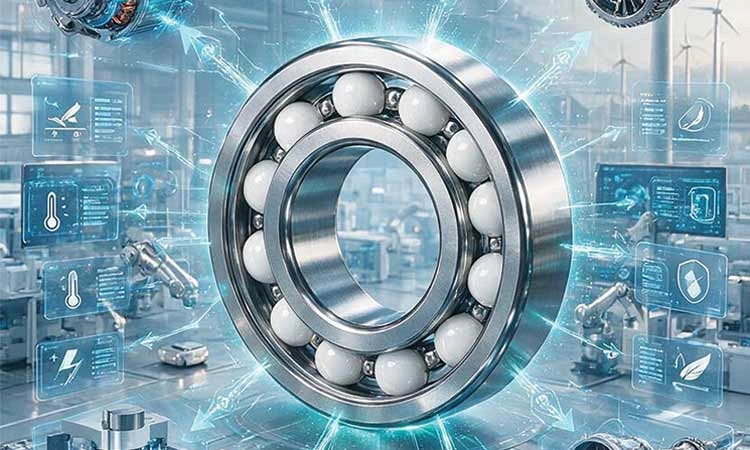
Hybrid ball bearings combine steel bearing rings with ceramic rolling elements, most commonly made from silicon nitride (Si₃N₄). This combination leverages the toughness of steel and the exceptional properties of advanced ceramics.
Unlike all-ceramic bearings, which are reserved for highly specialised environments, hybrid bearings offer an ideal balance of performance, durability and cost, making them suitable for a broad range of industrial and automotive applications.
Why Ceramic Balls?
Silicon nitride ceramic balls possess several remarkable properties that make them highly suitable for demanding applications.
Higher Speed Capability
Ceramic balls are approximately 60% lighter than steel balls. Their lower mass generates reduced centrifugal forces at high rotational speeds, enabling bearings to operate efficiently at speeds significantly higher than conventional steel bearings.
This makes hybrid bearings particularly valuable in:
- High-speed electric motors
- Machine tool spindles
- Dental equipment
- Aerospace systems
- Turbochargers
Lower Friction
The smooth surface finish and lower density of ceramic balls reduce rolling resistance, resulting in:
- Lower operating temperatures
- Reduced energy consumption
- Improved efficiency
- Longer lubricant life
Even small reductions in friction contribute significantly to energy savings in continuously operating industrial machinery.
Electrical Insulation
One of the greatest advantages of ceramic rolling elements is their non-conductive nature.
Variable Frequency Drives (VFDs), electric motors and EV powertrains often generate stray electrical currents that pass through conventional steel bearings, causing electrical erosion, fluting and premature failure.
Hybrid bearings interrupt this electrical path, protecting equipment from electrical damage while extending service life.
Superior Wear Resistance
Ceramic materials exhibit exceptional hardness and wear resistance.
They retain their dimensional accuracy even under demanding operating conditions, contributing to:
- Longer fatigue life
- Reduced surface wear
- Improved reliability
- Lower maintenance requirements
Corrosion Resistance
Although the steel rings remain susceptible to corrosion, ceramic rolling elements are highly resistant to chemicals and moisture.
This characteristic makes hybrid bearings suitable for humid or mildly corrosive environments where conventional bearings may experience accelerated wear.
Applications of Hybrid Bearings
Hybrid bearings are now widely used across multiple industries, including:
- Electric vehicles
- Railway traction motors
- Wind turbines
- High-speed compressors
- Industrial robotics
- CNC machine tools
- Medical equipment
- Aerospace systems
- Semiconductor manufacturing
- Vacuum pumps
Their ability to combine speed, durability and electrical insulation makes them indispensable in many advanced engineering applications.
Understanding Special Ball Bearings
Beyond hybrid designs, manufacturers offer numerous special ball bearings developed for unique operating conditions.
These bearings incorporate specialised materials, internal geometries, seals, lubricants or coatings to address specific engineering challenges.
Angular Contact Ball Bearings
These bearings are designed to accommodate combined radial and axial loads simultaneously.
Widely used in machine tool spindles, pumps and compressors, angular contact bearings provide high rigidity, excellent running accuracy and superior performance at elevated speeds.
Matched bearing pairs further enhance precision in demanding applications.
Thin-Section Bearings
Where space and weight are limited, thin-section bearings provide an excellent solution.
Despite their compact dimensions, they maintain high load-carrying capability and are commonly used in:
- Robotics
- Medical imaging equipment
- Aerospace systems
- Automation equipment
High-Temperature Bearings
Standard bearings lose lubrication effectiveness at elevated temperatures.
High-temperature bearings utilise specialised steels, heat treatment processes and advanced lubricants that allow continuous operation under severe thermal conditions found in furnaces, dryers and steel plants.
Stainless Steel Bearings
Applications in food processing, pharmaceuticals, marine equipment and chemical industries require superior corrosion resistance.
Stainless steel bearings offer excellent resistance to moisture, chemicals and cleaning agents while complying with stringent hygiene requirements.
Sealed and Shielded Bearings
Contamination remains one of the leading causes of bearing failure.
Sealed and shielded bearings protect internal components from dust, dirt and moisture while retaining lubrication.
Maintenance-free sealed bearings have become increasingly popular in automotive, consumer appliance and industrial applications.
Low-Noise Bearings
Electric motors, household appliances, HVAC systems and precision instruments require exceptionally quiet operation.
Low-noise bearings are manufactured with tighter tolerances, superior surface finishes and optimised internal geometry to minimise vibration and acoustic emissions.
Advanced Materials and Surface Engineering
Innovation in bearing technology extends beyond rolling elements.
Manufacturers now employ:
- Special steel alloys
- Diamond-like carbon (DLC) coatings
- Ceramic coatings
- Advanced cage materials
- Polymer retainers
- Nano-engineered lubricants
These developments improve wear resistance, reduce friction and enhance fatigue performance under demanding operating conditions.
Hybrid Bearings in the Electric Vehicle Era
Electric mobility has significantly accelerated demand for hybrid bearings.
EV motors routinely operate at speeds exceeding 20,000 rpm while producing instant torque and maintaining extremely low noise levels.
Hybrid bearings address these challenges through:
- Electrical insulation
- High-speed capability
- Reduced friction
- Lower operating temperatures
- Improved efficiency
- Longer service life
As EV production expands globally, hybrid bearing technology is expected to become increasingly mainstream.
Manufacturing Precision Matters
The performance of advanced bearings depends not only on materials but also on manufacturing accuracy.
Modern production facilities employ:
- CNC precision grinding
- Super-finishing
- Laser measurement systems
- Robotic assembly
- Artificial intelligence-based inspection
- Automated quality control
These technologies achieve micron-level dimensional accuracy, ensuring exceptional reliability and consistency.
Conclusion
Hybrid and special ball bearings represent the next generation of bearing technology, combining advanced materials, innovative designs and precision manufacturing to meet the demands of today’s high-performance machinery. Whether improving the efficiency of electric vehicles, enhancing the accuracy of machine tools or increasing the reliability of industrial equipment, these bearings are redefining what is possible in rotating machinery.