
Air Bearings for the Healthcare Industry: Enabling Precision, Cleanliness, & Quiet Motion
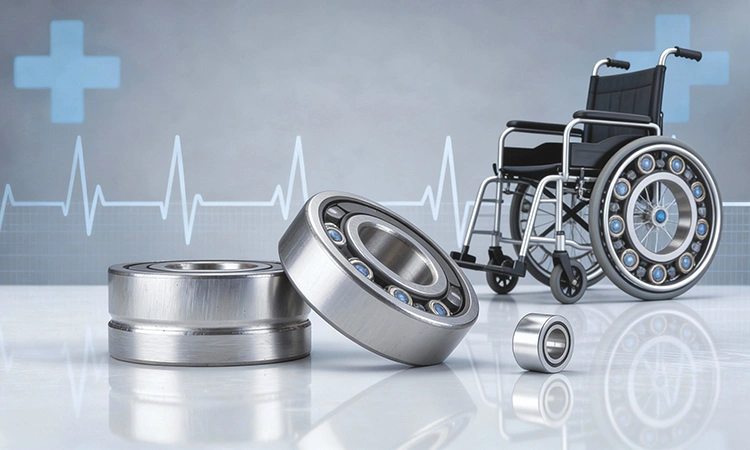
Advanced healthcare technologies increasingly rely on highly precise and frictionless motion systems to enhance diagnostic accuracy, improve patient comfort, and enable new forms of medical innovation. Traditional rolling-element bearings, although robust and widely used, introduce limitations such as vibration, particulate emission, lubrication requirements, and wear over time. For critical applications such as medical imaging, robotic surgery, microfluidics, and laboratory automation, these drawbacks can compromise both performance and the sterility of healthcare environments.
Air bearings—leveraging a thin film of pressurized air to support loads—have therefore emerged as a compelling solution, delivering ultra-precise positioning, cleanroom compatibility, and virtually silent operation. They enable smoother, faster, and non-contact motion essential to next-generation care.
Why Air Bearings Suit Medical Environments
The healthcare sector demands systems with high accuracy, low noise, and zero contamination. Air bearings inherently meet these criteria. Their non-contact operation eliminates metal-to-metal friction, leading to minimal vibration and exceptional repeatability—attributes crucial for imaging clarity and surgical precision. With no lubricants required, they eliminate oil spills and particulate shedding, ensuring compliance with stringent sterility and cleanliness norms in hospitals, diagnostic centers, and medical manufacturing facilities.
Enhancing Imaging System Precision and Patient Comfort
Magnetic Resonance Imaging (MRI), Computed Tomography (CT), and radiation therapy equipment require smooth linear or rotary motion to capture accurate internal body scans. Any vibration or positional error can distort imaging resolution. Air bearings provide nanometer-level positioning control and ultra-stable rotors—delivering sharper images with shorter scanning cycles.
Their whisper-quiet operation reduces patient anxiety, creating a more comfortable experience especially for pediatric and elderly patients or those with anxiety disorders. In proton therapy systems as well, air bearing-supported gantries allow precise beam targeting to reduce damage to surrounding healthy tissue.
Critical Role in Surgical Robotics and Micro-Positioning
Robotic surgery systems demand flawless repeatability in tiny, millimeter-level motions. Traditional bearings create micro-errors due to stiction and backlash, which can affect the surgeon’s control. Air bearings eliminate these mechanical inconsistencies, enabling safer, more controlled surgical procedures.
For delicate interventions—neurosurgery, ophthalmic procedures, or cardiac repairs—precision is non-negotiable, and air bearings ensure that every action of the robotic arm mirrors the surgical intent with zero lag or drift.
Supporting Cleanroom-Grade Laboratory Automation
Modern laboratory workflows involve automated pipetting, sample loading, and analysis—especially in genetic testing, vaccine development, and pharmaceutical manufacturing. Air bearings support fast and accurate positioning in high-throughput systems without shedding particles that may contaminate sterile samples.
Because they generate negligible wear, maintenance downtime is vastly reduced, improving equipment uptime in time-sensitive operations like blood sample screening.
Breakthroughs in Microfluidic and Analytical Instruments
Devices such as mass spectrometers, blood analyzers, and DNA sequencers require controlled rotational speed with minimal noise interference. Air bearings enable high-speed, precise rotation while conserving energy due to frictionless motion.
They also improve reliability in continuous testing environments, ensuring consistent results over extended operating cycles. For portable or near-patient diagnostic devices, newer compact air bearing designs enable miniaturization without performance compromise.
Advancing Patient Mobility and Rehabilitation Technologies
Although still emerging, air bearings show promise in mobility aids including lightweight wheel systems and smooth high-load lifting solutions for patient transfer. Non-contact mechanics reduce resistance, allowing caregivers to maneuver equipment with less effort and reducing patient discomfort.
Such innovation supports efforts to enhance ergonomics in caregiving settings—particularly in eldercare and long-term rehabilitation facilities.
Materials & Design Considerations for Medical Applications
To withstand sterilization cycles and hospital hygiene protocols, air bearings are engineered using corrosion-resistant materials such as stainless steel and advanced ceramics.
Porous media and precision orifice designs ensure uniform pressure distribution, supporting stable motion across variable loads. Engineers tailor bearing geometry and surface patterns to handle both linear strokes (bed movement systems) and continuous rotation (imaging rotors). Special vibration-damping housings are also deployed to maintain isolation from structural disturbances like HVAC-induced floor vibrations.
Reliability, Maintenance, and Cost Efficiency
While air bearing systems require an external air supply, their maintenance needs are minimal as there is no mechanical wear. The absence of lubricants translates to lower lifecycle costs, reduced cleaning needs, and greater uptime—critical in hospitals where uninterrupted operation of diagnostic assets can directly influence care delivery and patient outcomes.
Condition monitoring technology is now enabling remote performance diagnostics and predictive maintenance—further enhancing system reliability and operational economics.
Case Study: Air Bearings Elevating MRI Gantry Performance
A leading global manufacturer of MRI systems sought to improve scan sharpness and shorten image acquisition time while also enhancing patient experience. Their existing gantry platform, supported by high-precision mechanical bearings, introduced challenges such as slight vibration, periodic maintenance due to lubrication, and acoustic noise during rotation.
Even minor mechanical inconsistencies were enough to affect image clarity, especially during advanced neurological and vascular scans.
To overcome these barriers, the company integrated porous media air bearings into the MRI gantry rotation system. This strategic design transition delivered multiple benefits:
- Zero-contact and zero-friction motion ensured ultra-smooth rotation, eliminating micro-vibrations that previously blurred images.
- Whisper-quiet operation significantly reduced patient stress and discomfort in what is often a claustrophobic experience.
- Improved reliability and uptime due to elimination of lubricant contamination and wear-based maintenance.
- More precise scan alignment, enabling faster imaging cycles and improved diagnostic accuracy especially in soft-tissue studies.
Following field deployment in hospitals across Asia and Europe, the MRI systems equipped with air bearings reported a measurable improvement in diagnostic detail and a substantial reduction in service interventions. Radiologists noted clearer visualisation of minute abnormalities such as microvascular lesions and early-stage tumours — demonstrating how better mechanical motion directly enhances clinical outcomes.
This success is now encouraging broader adoption of air bearings in high-performance imaging platforms and is setting a new industry benchmark for motion quality in healthcare diagnostic technology.
Shaping the Future of Healthcare Engineering
Healthcare is experiencing a powerful shift toward digital accuracy, non-invasive procedures, and patient-friendly systems. Air bearings are uniquely positioned to support this evolution through unmatched motion precision, cleanliness, and low noise. As medical equipment designers push for faster image rendering, better surgical dexterity, and automated sample handling—air bearing adoption is expected to rise.
Continued improvement in compact compressors, integrated control systems, and hybrid bearing technology will further expand their feasibility in next-generation medical devices.
Where Air Bearings Make a Difference in Healthcare
Application Area | Performance Advantage |
MRI/CT Scanners | Smoother gantry motion, higher image resolution, reduced noise |
Robotic Surgery Systems | Zero-backlash micro-positioning, improved surgical precision |
Lab Automation Platforms | Particle-free motion for sterile sample environments |
Radiation/Proton Therapy | Precise beam alignment for targeted cancer treatment |
Analytical Instruments | High-speed rotation with consistent measurement accuracy |
Rehabilitation and Patient Handling | Ultra-smooth mobility with reduced caregiver effort |
Clean, frictionless motion is becoming a cornerstone of smarter, safer healthcare delivery.

