Opportunities & Challenges in the Aviation and Aerospace Industry
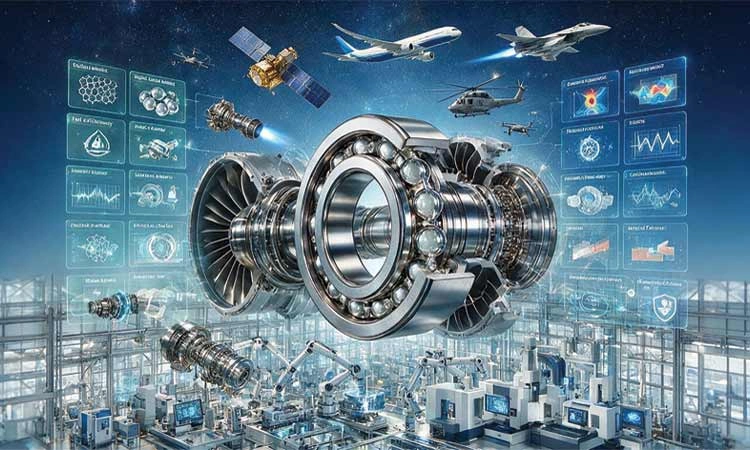
The aviation and aerospace industry represents one of the most demanding applications for bearing technology. Whether supporting the main shaft of a jet engine, guiding an aircraft’s landing gear, operating flight control systems or enabling satellite mechanisms in space, bearings perform critical functions where reliability is paramount. Unlike conventional industrial bearings, aerospace bearings must function flawlessly under extreme temperatures, enormous loads, high rotational speeds and challenging environmental conditions. A single bearing failure can have serious operational and safety consequences. As global air travel rebounds, defence budgets increase and space exploration gathers unprecedented momentum, the demand for advanced aerospace bearings is growing rapidly. For bearing manufacturers, this presents significant opportunities for technological advancement, product diversification and global market expansion. However, it also brings formidable challenges that require continuous innovation, stringent quality control and uncompromising engineering excellence.
A High-Value, High-Precision Market
The aerospace sector is not driven by volume alone but by performance and reliability. Every aircraft contains hundreds of bearings installed in engines, gearboxes, landing gear, flight control systems, auxiliary power units (APUs), hydraulic pumps, fuel systems and environmental control equipment.
Modern aircraft demand bearings that deliver:
- Exceptional precision
- High fatigue life
- Low friction
- Minimal weight
- Corrosion resistance
- Long maintenance intervals
- Reliable performance under extreme conditions
Unlike many industrial applications, aerospace bearings must often remain operational for thousands of flight hours while meeting stringent international certification standards.
Extreme Operating Conditions
Aircraft bearings operate under conditions rarely encountered in other industries.
Jet engine bearings, for example, experience:
- Rotational speeds exceeding 30,000 rpm
- Temperatures approaching 300°C or higher in certain zones
- Rapid acceleration and deceleration
- Continuous vibration
- Severe axial and radial loads
- Conversely, bearings used in aircraft operating at cruising altitudes must also withstand extremely low ambient temperatures.
Space applications present an even greater challenge, where bearings function in vacuum conditions, intense radiation and dramatic thermal cycling without conventional maintenance.
Advanced Materials Lead the Way
Meeting these demanding requirements begins with material selection.
Modern aerospace bearings increasingly utilise:
- Ultra-clean alloy steels
- Vacuum-melted bearing steels
- Case-hardened steels
- Stainless steels
- Titanium alloys
- Hybrid ceramic bearings
- Silicon nitride rolling elements
Hybrid bearings have become particularly attractive because ceramic balls are lighter than steel, reducing centrifugal forces at high speeds while providing excellent wear resistance and electrical insulation.
Advanced materials significantly improve fatigue life while reducing overall component weight—a critical consideration in aircraft design.
Lightweight Design for Fuel Efficiency
Weight reduction remains a primary objective throughout the aerospace industry.
Every kilogram removed from an aircraft contributes to:
- Lower fuel consumption
- Reduced emissions
- Greater payload capacity
- Increased operating range
- Lower operating costs
Bearing manufacturers are therefore developing compact designs using high-strength materials and optimised internal geometries that reduce weight without compromising load-carrying capacity or durability.
The Rise of Composite and Hybrid Technologies
The increasing use of carbon-fibre composites in aircraft structures is influencing bearing design.
Engineers must carefully address differences in thermal expansion between composite structures and metallic bearing components.
Hybrid bearing technologies, advanced coatings and specialised mounting arrangements help ensure dimensional stability and reliable performance under varying operating conditions.
Lubrication Under Extreme Conditions
Lubrication is one of the greatest engineering challenges in aerospace applications.
Aircraft engine bearings require specialised lubricants capable of:
- Withstanding extremely high temperatures
- Maintaining viscosity over wide temperature ranges
- Resisting oxidation
- Minimising deposits
- Providing long service life
Spacecraft bearings often require solid lubricants or specially formulated vacuum-compatible lubricants because conventional oils may evaporate or degrade in space.
Selecting the correct lubrication system is therefore as critical as selecting the bearing itself.
Precision Manufacturing Is Non-Negotiable
Aerospace bearings are manufactured to extraordinarily tight tolerances.
Production involves:
- Precision forging
- Ultra-fine machining
- Super-finishing
- Advanced heat treatment
- Laser metrology
- Automated dimensional inspection
- 100% traceability
Every production stage is carefully monitored to ensure compliance with demanding aerospace quality standards.
Micron-level dimensional accuracy is essential for reliable operation under extreme loads and speeds.
Certification and Regulatory Challenges
Unlike general industrial products, aerospace bearings must comply with rigorous certification requirements.
Manufacturers must satisfy internationally recognised quality management systems, extensive material traceability and exhaustive testing before components are approved for flight.
Qualification testing typically includes:
- Fatigue testing
- High-speed testing
- Thermal cycling
- Corrosion resistance evaluation
- Vibration testing
- Lubrication performance
- Endurance testing
While these requirements increase development costs and lead times, they also create high barriers to entry, rewarding companies with proven engineering capabilities.
Challenges That Remain
Despite promising opportunities, the aerospace bearing industry faces several challenges.
These include:
- High research and development costs
- Strict certification requirements
- Long product qualification cycles
- Dependence on advanced materials
- Supply chain disruptions
- Skilled manpower shortages
- Increasing global competition
- Counterfeit component risks
Manufacturers must continuously invest in innovation while maintaining uncompromising quality standards.
Future Trends
The future of aerospace bearings will be driven by advances in materials science, digital engineering and sustainable aviation.
Emerging technologies include:
- Sensor-integrated smart bearings
- Advanced ceramic rolling elements
- Nano-engineered surface coatings
- Additive manufacturing of bearing components
- AI-assisted design optimisation
- Digital twin simulations
- Self-lubricating bearing systems
- Bearings for electric and hybrid-electric aircraft propulsion
As sustainable aviation evolves, new propulsion systems and higher-efficiency engines will create fresh opportunities for specialised bearing solutions.
Conclusion
For India, the future is particularly encouraging. The country’s expanding aerospace manufacturing capabilities, strong engineering talent and increasing focus on indigenous production provide fertile ground for developing world-class aerospace bearings. Companies that invest in research, advanced manufacturing, international certifications and collaborative innovation will be well positioned to participate in the next generation of aviation and space programmes.
As aircraft fly farther, engines run hotter and space missions venture deeper into the cosmos, bearing technology will continue to evolve—quietly but decisively supporting humanity’s pursuit of flight, exploration and technological progress.